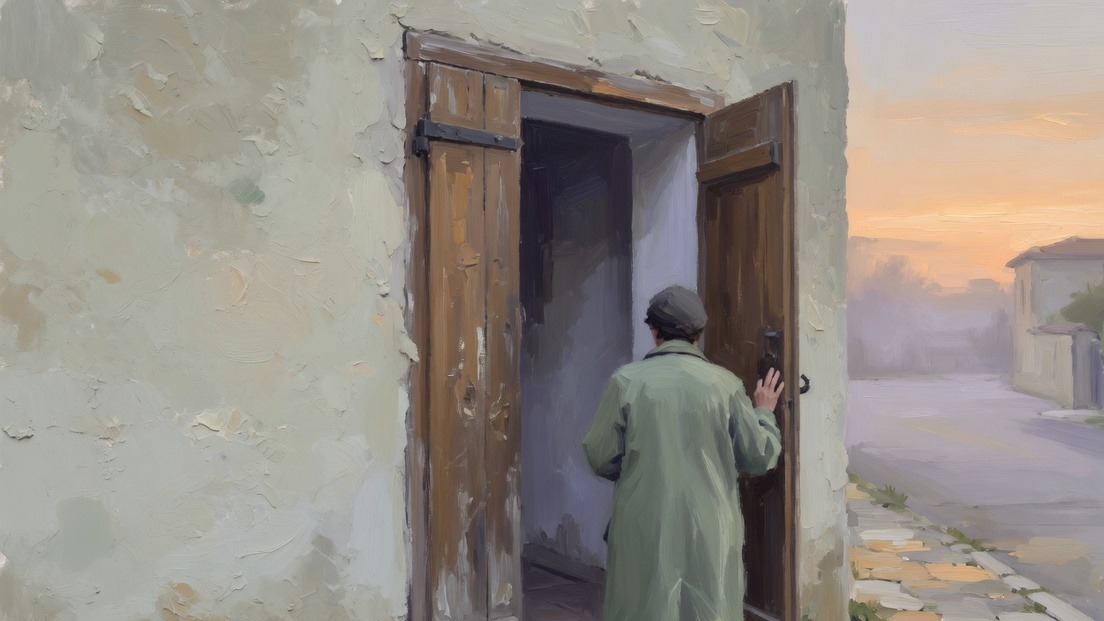
The cost of waiting
You have had the email drafted for eleven days. It asks your manager for the role you've been doing for a year without the title. It's three paragraphs long. You've read it forty times and changed one comma. Every morning you tell yourself you'll send it when you feel calmer, and every morning you aren't. Eleven days is nothing. But eleven days turns into eleven months, then eleven years. The email becomes a pattern: the conversation you never had, the page you never showed anyone, the move you saved for next year. Nobody decides this. It builds one reasonable delay at a time, and from the inside it feels like patience.
Courage is doing the next honest thing while you're still afraid.
Not after the fear goes. While it's still in the room. The fear isn't leaving. The only question is whether you walk in with it or stay out with it. This page is for people who already know what they should do and keep not doing it. It isn't a treatment for anxiety disorders. If anxiety is flooding you, won't let up, or is getting in the way of daily life, please see a doctor or therapist.
Why you stall
Three things get in the way, and they feed each other. You don't know what you're afraid of. It's a vague tightness, so you can't aim at it, and you end up busy with the wrong things for years. Avoiding pays you. The moment you skip the hard thing, you feel relief, and relief feels like a good decision. The cost, a slightly smaller life, comes later and in pieces too small to argue with. And you're waiting to feel ready. But ready usually shows up after you start, not before. It's what you feel looking back at a step you took while feeling nothing of the kind.
Find your stuck point
Find the sentence that sounds like the one in your head, then jump to that section.
| The sentence in your head | Go to |
|---|---|
| “Something's wrong and I can't say what.” | Name the fear |
| “I'll start when I feel ready.” | Sit the session |
| “I don't have the whole plan yet.” | Sit the session |
| “I have to be good enough first.” | Take the step anyway |
| “I'm not avoiding, I'm being sensible.” | Name the shrink |
| “That no means I'm finished.” | Strip the story |
| “One more miss and I quit.” | Strip the story |
| “Once this obstacle is gone, I'll start.” | Use the obstacle |
| “It won't change, so why try.” | Use the obstacle |
| “Everyone else is further ahead.” | Work for the work |
| “I can't say what I think in that room.” | Tell one true line |
| “I just say what they want to hear.” | Tell one true line |
Name the fear
Three moves, in this order, about twenty minutes in all. If you read nothing else, read these. Your chest is tight, your mind is buzzing, and you can't say what it's about. So you do the dishes. Then you wipe down the counters. An hour later the pantry is reorganized and the thing you were avoiding hasn't moved. That isn't laziness. It's what happens when a fear has no name. A vague feeling gives you nothing to act on, so your mind hands you something to do instead, and cleaning feels productive. The giveaway is the timing. The urge to do something else shows up the moment you sit down to the one thing that matters. So the first job is to name it. Not “stress” or “work.” Something you could point at: the email, the talk with your sister, the doctor's appointment, the Friday deadline. If you can't find a thing, it's usually one of three worries underneath. Something is ending, it doesn't matter, or people will see you're not good enough. Pick the one that stings. Then write it as a sentence. “I'm afraid of sending this email.” Go one step further if you can: “I'm afraid she'll say no and I'll know she doesn't value me.” That second line is the real one. Once it's on paper, the clean kitchen loses its hold, because you can see what you were dodging. And keep one rule: the more you want to avoid something, the more it probably matters.
If you do one thing today: finish this sentence on paper: I'm afraid of ___. If it still feels foggy, make the blank more specific, until it's something you could point to in the room.
Sit the session
You'll start when you feel ready. When the week calms down. When you've found the right plan, or the right time, or the right coffee. And the days go by. Here's the catch about readiness: it mostly shows up after you start. When people are treated for low mood, one of the first things they try is scheduling an action and doing it whether or not they feel like it, because the mood tends to follow. A perfect plan, a perfect mood and a guaranteed result are all delays that look respectable. So take the decision out of your mood and put it in your calendar. Pick a start time and an end time today, and treat it like a work shift. Decide the smallest step you can actually take, the call, the first paragraph, the apology, and begin it, badly if you have to. Then stay until the clock says stop. Around minute four, a very reasonable reason to leave will show up. Let it pass. You don't have to vote on it. Say you block 4:00 to 4:25 for the email. Phone in another room, nothing else open. At 4:04 you remember an invoice, so you write it on a sticky note and go back. At 4:25 the email is one click from sent. When the time is up, ask one question: did I do this step with care? If yes, the session counts, whatever happens next. If you walked out at minute four, make tomorrow's session shorter, but don't leave early. If the plan fell apart, ask what the attempt taught you and go again.
If you do one thing today: put a twenty-five-minute session on your calendar and keep it.
Take the step anyway
You've decided you'll move once you've earned it. Once the email is perfect. Once you're sure. Once you've proved yourself so thoroughly that nobody could say no. Notice how the bar keeps rising. Every time you clear it, there's another one behind it. That's the trap. You're trying to earn permission to act, and nobody is coming to hand it over. Success, being right, being good enough, being included: each of them gives you relief for a while, then asks for more. You can't buy your way into being allowed to move. You were allowed the whole time. So find the thing you're waiting to be enough of, and say it plainly: “I'm waiting until I'm good enough.” Then say it's too small to run your life on. Out loud, if you can: “I'm here. I don't have to be finished to take the next step.” Then take the step. Send the email, have the talk, make the repair. Standards are good tools. They make bad gatekeepers. At 4:22 the email still isn't perfect and your hands aren't steady. You press send. If you catch yourself waiting for a sign that it's okay, that's the same trap in a new coat. No sign is coming. The step is the yes.
If you do one thing today: say that sentence out loud once, then do the step.
Name the shrink
Once you're moving, these five cover the usual things that get in the way. Nobody decides to live small. It happens in installments. You skip the hard conversation, and the relief is instant and physical. Your body learns that skipping works, so next time the fear is louder and the skip comes quicker. That's how anxiety outlives whatever started it. It goes by respectable names: being sensible, staying busy, keeping the peace, not wanting to make a fuss. Some caution is real good judgment. The test is whether you can say what you're getting and what it's costing you. So write down what you're refusing: a talk, a risk, a page you haven't shared. Then say the trade out loud: “I'm buying relief with a smaller life.” Then take back one inch. Spend five minutes inside the thing you've been avoiding, and stay for the whole five. Say you realize you stopped speaking up in planning meetings eight months ago and called it letting others lead. This week you speak once, for five minutes. If the inch feels too big, cut it in half. And if anxiety floods you, get a doctor involved and still take the smaller inch.
If you do one thing today: write down the one thing you've avoided longest.
Strip the story
The reply comes back: “Not this quarter.” Within a minute your mind has written a whole story. She doesn't value me. I'm stuck here. I'm done. Look closely and there are two things in there. One is what happened: she said not this quarter. The other is the sentence you added. The first is a fact you can deal with. The second is a verdict, and a verdict can only be obeyed. A lot of what hurts after a setback is the story, not the event. The philosopher Epictetus said it two thousand years ago: people are upset less by things than by the views they take of them. So write the fact and nothing else. “The reply was: not this quarter.” Cross out everything extra. Then draw two columns. In one, put what's up to you: your next move, your next sentence. In the other, what isn't: her decision, the past, her timing. Spend ten minutes in the first column only. Then treat the miss as information, not a ruling on what you're capable of. Ask what effort is left, what you haven't tried, and who you could ask. Book one more attempt, a smaller one if you need to, and notice what you did well: you sent it, you came back, you asked. You write the fact, cross out “she doesn't value me,” and send one line back: “What would make this a yes?” Then you book fifteen minutes. If the story keeps creeping back in, look for the words always, never and because. That's usually where the verdict hides. And if “not yet” has turned into a slogan, pair it with something you'll do differently.
If you do one thing today: write down what happened as a plain fact, then cross out one verdict.
Use the obstacle
You're waiting for the problem to leave before you start. Or you keep trying the same door and getting the same no. Write the obstacle in one sentence. Then use it. “Not this quarter” can become a smaller ask: lead one project now, and put a title review in January in writing. If the direct ask has already failed twice, change it. Make the ask smaller, make a simpler version, or talk to a different person. That is the use Marcus Aurelius meant. The block in the road is the work, and you start there.
Some obstacles will not move. A diagnosis, a final decision, a loss. Ask once whether you can still change it. If you can, waiting is only a way to avoid it. If you can't, keep what is still yours: your tone, your next task, and whether you add bitterness. Write three lines: “If that happens, I will ___.” Then leave the argument with the life you thought you were owed.
If you do one thing today: write one way to use the obstacle in front of you. If it will not move, write one line: “If that happens, I will ___.”
Work for the work
One glance at someone else's numbers and your hour is gone. Their promotion, their launch, their follower count. Suddenly you're not doing the work. You're auditioning for judges who aren't in the room and are never satisfied. Work done to be seen turns into a performance. The alternative is to have a place where you work for its own sake: the desk, the route, the practice room you'd go back to even if nobody ever knew. Being recognized matters, and rent depends on it. It just doesn't belong inside the work session. So close the comparison tabs until the session's over. Say where you are: “I'm here to do this.” Ask yourself: would I do this if nobody knew? And leave the reactions alone. Don't refresh. A colleague's promotion post lands halfway through your session. You close the tab. The session runs to the end. If the honest answer to that question is no, that's useful too. It means you're playing the wrong game today. Pick work you'd do unwatched.
If you do one thing today: block the comparison sites for one work session.
Tell one true line
There's a room where you can't say what you think. Or a group you've never quite felt part of. Or you've been nodding along for so long you've forgotten what you'd say. The Czech playwright Václav Havel told a story about a greengrocer who puts a sign in his shop window: “Workers of the world, unite!” He doesn't believe it. Nobody reading it does. He puts it up because it says he's obedient, and obedient is safe. Havel's point was that whole systems run on millions of small private lies like that one, which means they also run on small quiet refusals. You don't have to topple anything. Every family and every office has its own signs: the slogan everyone repeats, the meeting that steps around what everyone can see. The goal is to line up what you know, what you say and what you do, at a scale you can survive. First, notice which way you lean. Some people go along too much and lose themselves. Others stand apart so much they end up alone. Then name the sign you've been displaying and pick something small enough to pay for: one sentence to one person, one thing you won't copy, one promise you'll keep. If you lean toward going along, make it an act of standing that costs you a little belonging. If you lean toward standing apart, make it an act of joining that costs you a little pride. You tell a colleague you trust: “I've been saying I'm fine with my scope. I'm not.” Don't turn it into a costume or a new identity as the brave one. And if it goes badly, the scale was too big. Shrink it until you could pay the bill. A truth you can't survive telling isn't the one to tell today.
If you do one thing today: say one true sentence to one safe person.
Your first seven days
If you stall anywhere in the week, find the sentence in your head in the table above and run that section.
| Day | Move | Time |
|---|---|---|
| 1 | Name the fear. Write “I'm afraid of ___.” | 10 min |
| 2 | First session: the smallest step, until the clock says stop. | 25 min |
| 3 | Second session, same hour. | 25 min |
| 4 | Take the step anyway: send it, say it, do it. | 5 min and the nerve |
| 5 | Strip the story: write the fact, two columns. | 10 min |
| 6 | Tell one true line to one safe person. | 5 min |
| 7 | The weekly ledger. | 15 min |
The weekly ledger
Fifteen minutes, once a week. Keep it kind, specific and short. This is accounting, not punishment.
- What did I avoid, and what was the fear called?
- Which inch did I take back?
- Which sessions did I stay in until the clock said stop?
- What one true thing did I say or keep?
Where this stops
These are everyday practices, not a diagnosis or a treatment. Please get professional help if anxiety is flooding you, won't let up, or has kept you from work, relationships or basic tasks for weeks, or if you feel unsafe or a situation involves abuse. Courage isn't recklessness, and some fears are right. They're telling you something true about the world. If your safety is at risk, build support and a plan before you confront anything. A truth worth telling is one you can survive telling. See also Fear and Attention.
Back to the email
You've had it drafted for eleven days. Nothing about you has changed. Your pulse is the same and the sentences are no better arranged. What's different is that you know the name of the fear. You know the urge to go clean something is the fear in ordinary clothes. You know ready arrives after the send, never before it. The fear can stay. The act is the courage. Open the email and send it.