Topics · Zen, Meditation and Spirituality · Spirituality
Spirituality
Spirituality is the human attempt to make contact with something larger than the everyday self — and to live in alignment with what you find there.
This page orients the territory — not a practice map. For tools you can run today, open I Am, When Lost, Sitting, or Mindfulness in the same family.
Spirituality is the human attempt to make contact with something larger, deeper, or more real than the everyday self, and to live in alignment with what you find there.
It is hard to define precisely because it is not one doctrine. It is a dimension of human life — like intellect or emotion — that shows up differently in different people. Some meet it in a cathedral. Some on a trail. Some in a therapy room after a loss they could not think their way through. The form changes. The pull toward depth does not.
This page names what that pull tends to involve and where the practice maps on this site pick up the work.
What most definitions share
Across traditions and even secular uses, spirituality tends to braid three threads.
1. A search for meaning. Not only how the world works, but why it matters that it exists. Why am I here? What is ultimately real? What should I do with a Tuesday when nothing dramatic is happening and I still feel the weight of being alive?
Meaning questions are not lazy philosophy. They arrive when explanation runs out — after achievement, after grief, after the plan worked and the room still felt empty. Spirituality is one name for what happens when a person stops treating those questions as decoration and starts living as if the answers might change how they speak, spend time, and treat the next person in front of them.
2. A sense of connectedness. The feeling that you are not a separate fragment, but part of something wider — whether that is called God, Brahman, Tao, Nature, humanity, or Consciousness itself.
Connectedness can be warm or stark. It can feel like love pouring through a crowd, or like the quiet recognition that the boundary between “me” and “this” was never as solid as habit claimed. Either way, the usual loneliness of being one body in one room thins for a moment — and sometimes that moment rewires what you are willing to do for a stranger.
3. An experience of transcendence. Moments when the usual boundaries of ego, time, and self-interest thin out. People describe it as awe, clarity, peace, presence, love, or being “at home.”
For some people this is explicitly sacred. For others it is entirely secular, but still concerned with depth rather than surface. A sunset can move you without requiring a creed. So can holding a dying parent’s hand. Transcendence is not always fireworks. Often it is the ordinary world suddenly seen without the usual filter of hurry and self-defense.
Four major ways people frame it
Not a menu you must choose from once. Most lives touch more than one.
1. Theistic / devotional lens. Spirituality as relationship with the Divine. Bhakti, Christian mysticism, Sufism. The goal is union, surrender, love. Practice is prayer, worship, service.
Here the sacred is personal — a Thou, not only a force. Devotion does not mean abandoning reason. It means the heart has a direction, and repetition (chant, liturgy, prostration) trains attention toward that direction until service to others stops feeling like a separate department from “spiritual life.”
2. Non-dual / contemplative lens. Spirituality as seeing through illusion. Advaita Vedanta, Zen Buddhism, Taoism. The key insight is that the separate self is not fundamental. Practice is self-inquiry, meditation, mindfulness.
This is the lane most of our practice maps speak from — not as doctrine to adopt, but as a workable suspicion: the commentator in the head is not the whole show. Sitting and Mindfulness are tools here. Rumination is what happens when the commentator runs the room.
3. Psychological / humanistic lens. From thinkers like Viktor Frankl, Maslow, Jung. Spirituality is the peak of human development — self-actualization, finding purpose after suffering, integrating shadow and wholeness. It does not require supernatural beliefs.
Frankl’s move after the camps: meaning can be chosen even when freedom is stripped to almost nothing. Jung’s move: wholeness includes what you disown. The spiritual task becomes honest encounter with grief, envy, and fear — not a prettier costume worn over them.
4. Secular / existential lens. No God, but still depth. Spirituality found in nature, art, ethics, wonder at the cosmos, deep connection with others. The sacred is not supernatural, but supremely valuable.
Einstein on the cosmic religious feeling. A parent who stays present through a child’s rage without becoming rage. An artist who loses the sense of separate doer in the work. None of this requires a metaphysical claim — only the refusal to live entirely on the surface.
What it looks like in practice
Varied forms, one function: interrupt automatic living and create space for attention.
Contemplative: meditation, vipassana, zazen, self-inquiry, silent prayer, breathwork — including the ratio work in Breathing Patterns when the body needs a lever before the mind will listen.
Embodied: yoga, fasting, pilgrimage, walking in nature, conscious work — the insistence that spirit is not only ideas; it lives in posture, pace, and what you do with your hands.
Relational: seva or selfless service, compassion practices, sangha or community, dialogue — depth tested in whether you can stay kind when tired.
Expressive: chanting, music, poetry, journaling, ritual — forms that let the unsayable move without forcing it into a spreadsheet.
Experiences that people often call spiritual include awe, deep inner quiet, a sense of being guided, sudden clarity about what matters, compassion that goes beyond personal like or dislike, and flow states where doer and doing feel like one.
None of these are trophies. Chasing them is how practice turns into performance. The useful signal is simpler: after the moment, is there slightly less harm — in speech, in hurry, in the story you tell about who owes you what?
Modern psychology also names pitfalls — spiritual bypassing, using spiritual ideas to avoid psychological wounds, grief, or practical responsibility. Bright language about oneness can become a way to skip the apology, the boundary, the bill, the therapist.
Spiritual materialism is another: collecting peak experiences, identities, and teachers while the ordinary Tuesday remains untouched. The check is always the same. Does this make you more available to the life in front of you — or more special inside your head?
Why people pursue it
Not because life is broken. Because explanation alone does not satisfy.
Science can tell you how a sunset works. Achievement can give you status. Neither necessarily leaves you at peace when alone on a quiet night. Spirituality is the attempt to close that gap — to have a way of living that feels true both inside and outside.
You do not have to solve every metaphysical question first. You only need to notice where your current map fails — where success, distraction, or certainty run out — and take one honest step toward depth. On this site, that step is usually small and bodily: one breath, one sit, one return when the mind has wandered, one fear met without fleeing.
If you want a door: start with When Lost when you do not know which practice to use. Start with Sitting when you are ready to show up for ten minutes without grading the result.
This page orients the territory in our own words. It is not a creed and not a substitute for teachers, texts, or care you may need. If a particular book or tradition helped you see something here, buy or borrow the original.
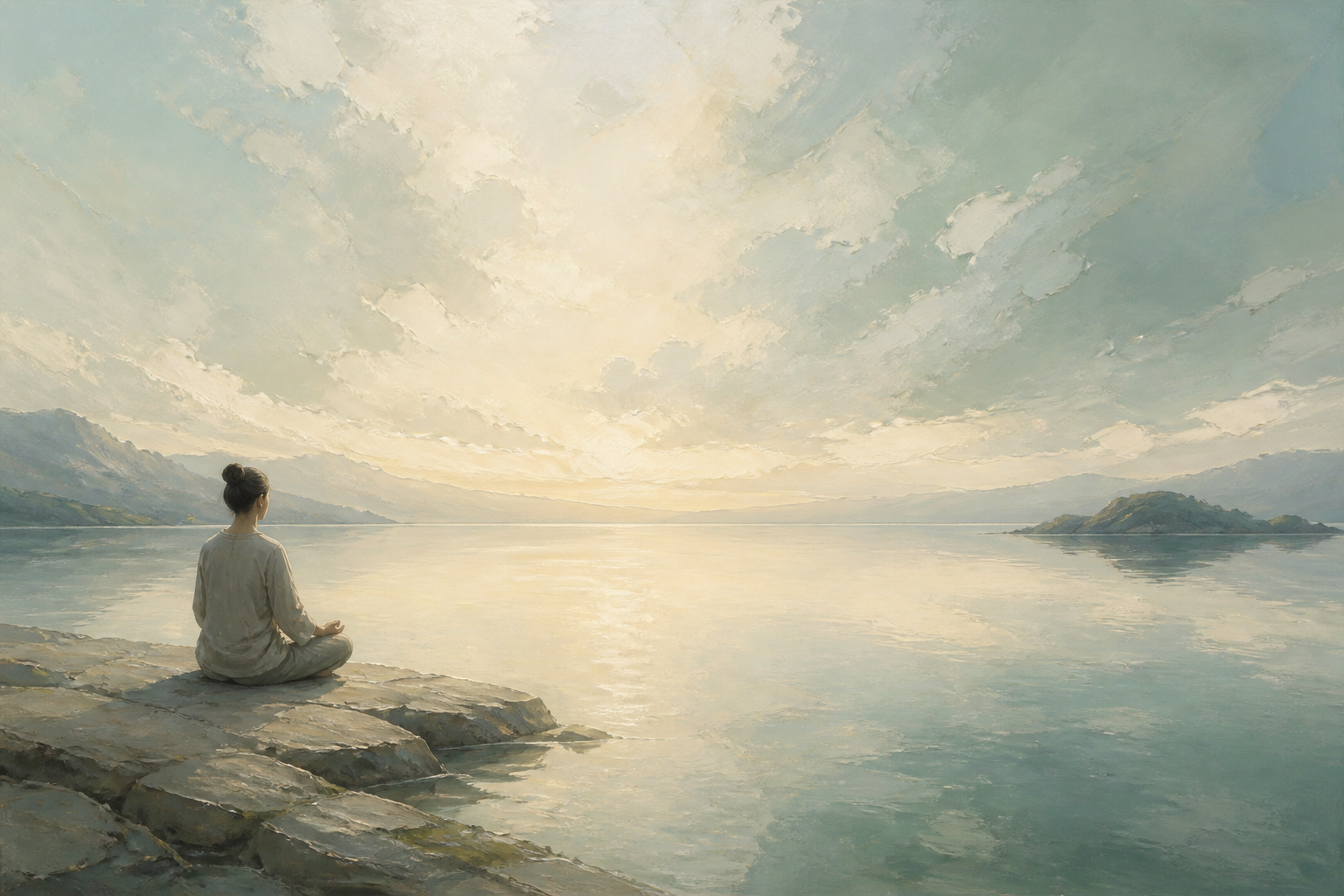
Illustration generated for this page.